Category: Blog

  • The “Pleaser” Saboteur

    The “Pleaser” Saboteur

    Sometimes it’s not external circumstances that hold us back, but inner voices that keep us small. These voices are called saboteurs. They show up especially when we step into responsibility or need to make bold decisions. One of the most well-known and at the same time most deceptive is the “Pleaser.” It makes us believe that we are only successful and accepted if we keep everyone happy. But that often prevents us from acting clearly, confidently, and authentically.

    What is the Pleaser Saboteur?

    Especially women know it well: the inner “Pleaser.” From an early age, we’re taught to be nice girls, to please others, and to avoid conflict. This pattern shapes us and can later become a real obstacle. When we move into leadership positions, it often becomes difficult to make tough decisions or have hard conversations. Instead, the Pleaser Saboteur takes over and convinces us that we must satisfy everyone in order to gain approval and belonging.

    The Psychology behind Saboteurs

    Inner saboteurs are deeply rooted patterns of thought and behavior, often formed in childhood. Back then, they were useful strategies to gain love, safety, or recognition. Today, however, they run automatically, often outside of our awareness. Neuroscience shows that they are ingrained neural pathways that are triggered over and over again. That’s what makes them feel so natural and powerful. Change only becomes possible when we learn to recognize, name, and consciously practice new ways of responding.

    Positive Intelligence: Discovering Your Saboteurs

    The Positive Intelligence framework identifies different saboteurs that influence our thinking and actions—among them the Pleaser, the Controller, and the Hyper-Achiever. Each of us carries a unique mix. Once we understand which saboteurs dominate our inner dialogue, we can begin to handle them differently. A helpful tool is the free Saboteur Assessment from Positive Intelligence. It reveals which saboteurs are most active in you and offers valuable insights for your personal development.

    How I deal with Pleasers

    I’ve learned to look at decisions not only from the perspective of individuals but always with the bigger picture in mind. When I understand why a decision is necessary and what purpose it serves, it becomes much easier to communicate it clearly. Empathy remains important, but it must not become an excuse to water down decisions.

    Leadership doesn’t mean pleasing everyone, it means taking responsibility and providing clarity. Marcus Aurelius once put it perfectly: “If it is not right, do not do it; if it is not true, do not say it.”

    Strategies for Handling the Pleaser Saboteur

    1. Develop Awareness

    The very first step is awareness. As soon as we notice that the Pleaser is in the driver’s seat, we create space to choose a different response. But how can this work in everyday life?

    A helpful strategy is to ask yourself: “Am I doing this because it truly makes sense—or because I want to be liked?” That single question alone brings clarity.

    2. Ask yourself “Why”

    Another powerful approach is to strengthen your personal “why.” When you have a clear picture of the purpose or value behind a decision, it becomes much easier to stand firm—even when you face resistance.

    3. Small Steps

    Another tip is to practice setting boundaries in small steps. Saying no to a request can feel difficult, even when you don’t have the time or it simply doesn’t fit. I know—it’s not easy. The best way to work on it is gradually. For example, once a week, say “no” when you really don’t want to or can’t do someone a favor. That means not automatically jumping into the helper role. Every small step strengthens the sense that your worth is not defined by others’ approval, but by your inner clarity.

    Balancing empathy and clarity is also essential. The goal isn’t to become cold or distant, but to communicate kindly and respectfully—without losing sight of your own needs and goals.

    Take over the control of your inner Pleaser! Jointly we will develop a step-by-step plan on how to deal with your Pleaser and other saboteurs

    Coaching-Exercises:

    • The Saboteur Journal: For one week, write down situations where your Pleaser showed up. Note what it told you and how you reacted. This builds awareness.
    • The Conscious “No”: Choose a safe situation where you’d usually agree and deliberately say no. Notice that the world doesn’t fall apart.
    • The Inner Dialogue: When the Pleaser speaks up, respond internally: “Thank you for trying to protect me, but today I’m making a different choice.”
    • The Values Check: Write down your three-five core values and measure your decisions against them. If something doesn’t align, it’s often your Pleaser talking.

    In Episode 012 of my Podcasts #HerPerspective: Women who inspire I talk with Prof. Dr. Helena Liebelt about the Pleaser and how she dealed with it. Worth listening – available in German only.

    Coaching: How to live with the Saboteur

    As a coach, I help my clients identify their saboteurs and develop new ways of dealing with them. I believe we cannot completely silence these voices. But we can learn to live with them, to notice them, and to stop letting them run the show. This is where the opportunity lies—not in fighting saboteurs, but in choosing consciously how we respond to them.

    If you want to understand your own saboteurs better, start with the free assessment from Positive Intelligence. It’s often the very first step toward making unconscious patterns visible and creating real change.

    Discover your saboteurs: Positive Intelligence Assessment

    Conclusion

    The Pleaser Saboteur often works invisibly, but it shapes our thoughts and actions more than we realize. Recognizing it is the first step. The second is to actively train strategies that foster clarity, boundaries, and inner strength. Saboteurs aren’t enemies we must eliminate—they are old patterns we can learn to relate to differently. When we do, we gain freedom, authenticity, and true leadership presence.

    Take over the control of your inner Pleaser! Jointly we will develop a step-by-step plan on how to deal with your Pleaser and other saboteurs

  • Job Search Guide for Experienced Professionals

    Job Search Guide for Experienced Professionals

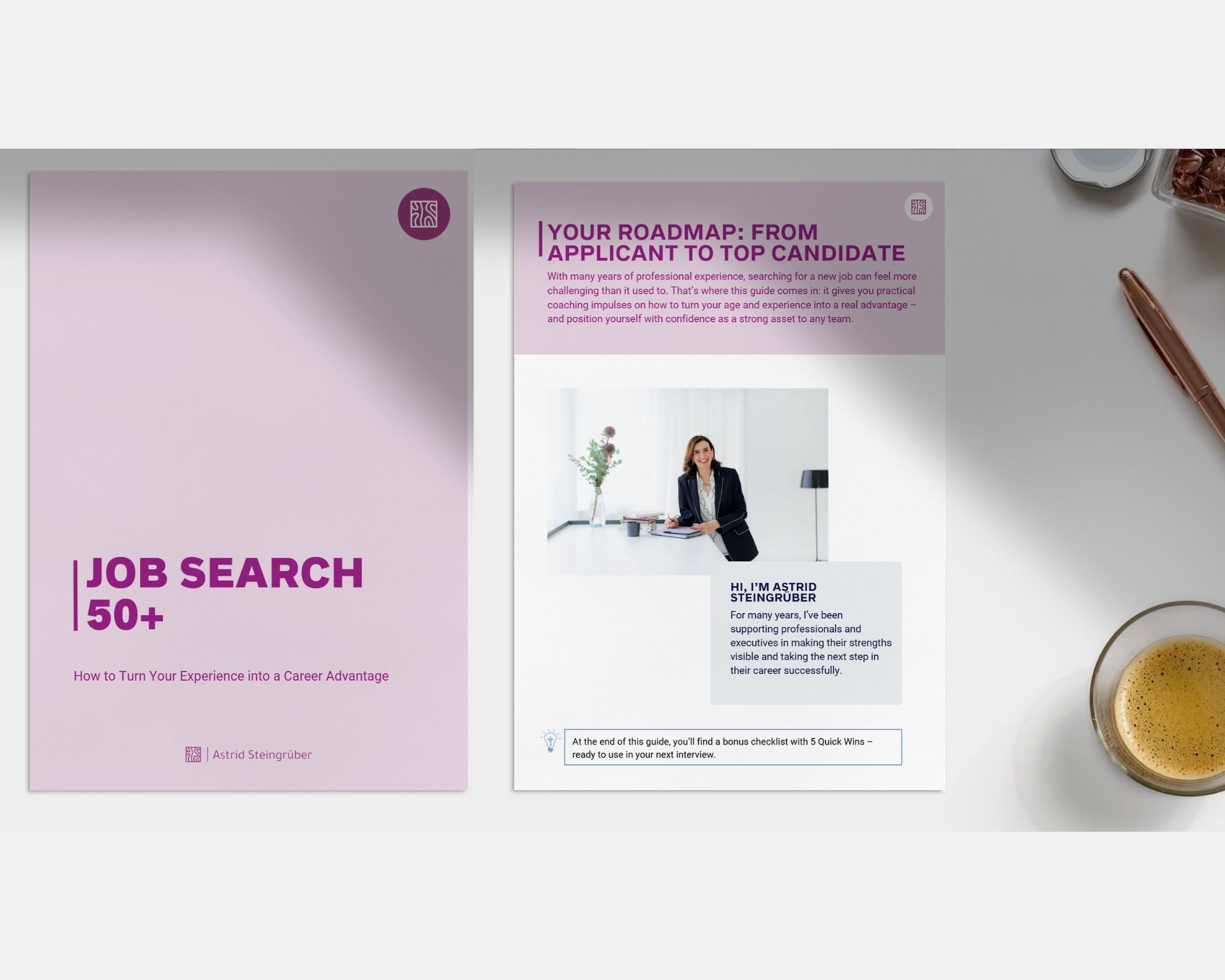
    With years of professional experience, job searching can feel more challenging than it once did. This guide meets you right where you are: it provides practical coaching impulses on how to use your age and experience as a strength – and position yourself with confidence as a valuable asset to any company

    What you get

    • 9-Page PDF Guide (in German + English)
    • Proven strategies for LinkedIn, CV, and interviews
    • Bonus Checklist: 5 Quick Wins before every interview

    Enter Your Next Job Interview Confidently – With the Free Career Toolkit for Professionals 50+

    Free PDF-Guide Job Search 50+

    Do you sometimes doubt yourself – despite all your success?

    You’re not alone. In coaching we’ll get to the root of your self-doubt and discover how you can confidently take your next career step.


  • The STAR Method for Job Interviews

    The STAR Method for Job Interviews

    Confident in Job Interviews with the STAR Method – Here’s How to Prepare

    Job interviews are rarely relaxed and often nerve-racking. But they don’t have to be chaotic or unstructured. One method that has helped me personally and that I often recommend to leaders, coachees, and students is the STAR method.

    It not only helps you prepare effectively, but also stay clear, structured, and confident during the interview – even when you’re nervous.

    What is the STAR-Method?

    STAR stands for:

    • SSituation: What was the context?
    • TTask: What was your specific task, role or challenge in this situation?
    • AAction: What exactly did you do?
    • RResult: What was the outcome? Ideally with a measurable impact (use data if you can)?

    This structure makes it easy for your interviewer to follow your story and ensures you stay focused. In a job interview, that’s invaluable.

    How to Use the STAR Method to Prepare for Your Interview

    1. Analyze the job posting

    Read through the job description carefully and ask yourself

    • What makes this role successful?
    • How will success likely be measured in this position?

    Pro tip: Sometimes it’s stated directly (“success measured by KPIs”), other times you’ll need to read between the lines (“close collaboration with sales” or “building new processes”).

    2. Identify the real success factors, skills

    Ask yourself: Which of the listed skills, qualifications, or experiences are truly essential to succeed in this role? What would someone need to be really good at to make a difference here?

    Pick the top 3 to 5 key skills or qualities that seem critical – not every bullet point carries equal weight.

    3. Match your strenghts and skills

    Now it’s your turn: Which of those 3–5 key requirements do you already bring to the table?

    Ask yourself:

    • Where have I demonstrated this skill before?
    • In which job, project, or context did I apply it successfully? Even if it is in your role as sport team coach – all counts.

    4. Prepare your STAR stories

    For each of those key skills, prepare one clear story using the STAR format.

    Write them down. So you remember them:

    • S (Situation): Where were you? What was the context?
    • T (Task): What was your task?
    • A (Action): What exactly did you do? (Never talk about “we“)
    • R (Result): What happened as a result? (share numbers and data if possible, what impact did you have?)

    The best part: you don’t have to memorize every word. If you’ve prepared the story well, you’ll be able to tell it naturally and your interviewer will stay engaged until the end. The last thing they hear? Your concrete result. Powerful.

    Tip: Stay with the STAR-Method flow of story telling. This makes it easier for the interview to follow what you’re telling them.

    Why the STAR-Method Really Works

    • Structure gives confidence: When you’re nervous, structure is your best anchor.
    • You stay on track: No rambling, just focused, relevant stories.
    • You appear more confident: You’ve thought it through and know your worth.
    • You highlight your impact: Results make your value tangible.

    My Conclusion: Better Prepared, Clearer Communication, Stronger Presence

    I’ve recommended the STAR method countless times and it has helped me immensely in my own interviews. It forces you to be specific. It turns your achievements into clear, memorable stories. And most importantly: it gives you the confidence that you have something valuable to offer.

    So: take the time to prepare your stories. You’ll walk into the room with more focus, more clarity and more belief in yourself.

    Wishing you the best for your next interview. You’ve got this and STAR will help you show it.

    Want to feel more confident and focused in your next interview?

    Struggling to make sense of long job descriptions and unclear expectations?

    Let’s take a closer look together. I can help you decode the role, identify what really matters, and craft your STAR stories so you can show up with clarity and confidence.
    With the right preparation, interviews become a whole lot easier—and more impactful.

  • Personal Branding: How to Stand Out in Large Companies

    Personal Branding: How to Stand Out in Large Companies

    Personal Branding for More Visibility, Authenticity, and Career Success

    “I’m not like you, I’m different like you.”

    Visibility has never been easier – whether on LinkedIn, in internal chats, or during online meetings, we’re constantly present.
    And yet: especially in large organizations, many of us still feel invisible.

    Personal branding often gets tossed around as a buzzword.
    But what does it really mean? And how can you position yourself authentically – without pretending to be someone you’re not?

    I’ve been there myself.
    When I started at a global tech company over 20 years ago – with more than 100,000 employees – I thought: No one knows me here. My career will get lost in the crowd.

    But things turned out differently.

    What Is Personal Branding – and Why Does It Matter Inside a Company?

    Personal branding is more than just a logo or a polished LinkedIn profile.
    It’s about how others perceive you – your strengths, values, communication style, and the unique perspective you bring to your work. It’s about presenting a clear, credible image of who you are – both inside and outside the organization.

    Because:

    • Those who are visible get recommended for new projects or even new roles – think sponsors, not just mentors.
    • Those with a clear profile are seen as experts.
    • Those who show up authentically build trust – which is especially critical for leaders.

    In large organizations, where it’s easy to feel like just another name in the system, personal branding helps you stand out.
    It makes your contributions visible, builds trust, and opens up opportunities – from cross-functional projects to leadership roles.

    But here’s the key: authentic personal branding doesn’t mean constantly promoting yourself.
    It means showing up consistently, being clear about what you stand for, and creating connections that go beyond your job title.

    5 Steps to Building an Authentic Personal Brand – for Greater Visibility at Work

    Step 1: Who Are You, Really?

    Your personal brand starts with self-awareness and reflections.
    You can only position yourself clearly if you truly know who you are or how do you expect other to know who you are?

    Reflection questions:

    • What are my strengths and values?
    • What topics genuinely excite me?
    • What kind of feedback do I regularly receive?

    Personal branding isn’t something external – it begins within.

    Step 2: How Are You Perceived?

    Many people have a distorted self-image, influenced by what they think others think of them.
    This happens subconsciously – but you can make it visible.

    “I’m not who I think I am. I’m not who you think I am. I am who I think you think I am.”Charles Horton Cooley

    The key to a strong personal brand is aligning how you see yourself with how others see you.
    Actively seek feedback. It will show you how you actually come across – and where your profile can be sharpened.

    Step 3: Work on Your Blind Spots

    Blind spots are behaviors or traits you’re unaware of – but others notice immediately.

    Identifying them isn’t easy, but it’s essential to building a consistent and authentic brand.
    Tools like coaching, 360° feedback, or peer reflection can be invaluable here.

    Step 4: Craft Your Personal Brand Narrative

    NNow it’s time to turn your insights into something tangible – your personal story.
    A great way to start is with your elevator pitch:

    • Who are you?
    • What do you do?
    • What do you stand for?
    • What makes you unique?

    Pro tip: Avoid clichés and speak in your own voice. You don’t need to memorize perfect sentences – it’s about being clear on your core message.
    That’s what makes it stick – even in a quick elevator conversation.

    Step 5: Share Your Brand – with Natural Presence

    Now it’s about showing up – not loudly or aggressively, but with authenticity and ease.

    Good opportunities include:

    • Project presentations
    • Internal networking events
    • LinkedIn posts
    • Informal conversations with senior leaders

    Use social media not for self-promotion, but as a stage for your ideas.n als Bühne für deine Haltung, Ideen und Werte. Selbstvermarktung darf menschlich sein. Aus meiner Sicht, muss sie das sogar.

    Conclusion: Your Personal Brand Is Your Career Accelerator

    When you know who you are, how you’re perceived, and what sets you apart, you become:

    • more visible within your organization
    • more confident in how you present yourself
    • and more successful in shaping your career path

    Personal branding isn’t a nice-to-have — it’s essential if you don’t want to be overlooked.
    The clearer you are about who you are, the more confidently you’ll show up. unterzugehen. Je klarer du dir darüber bist, wer du bist, desto selbstbewusster wirst du auch.

    Don’t wait for others to define you – start building your personal brand intentionally.

    In coaching, we explore together:
    Who are you really – and how are you perceived?
    We uncover blind spots, sharpen your profile, and define what you want to stand for.

  • Imposter-Syndrome: Why doubt yourself?

    Imposter-Syndrome: Why doubt yourself?

    You have a good job, you’re engaged, competent and you’re getting a lot of positive feedback. Still there’s this lingering feeling, your don’t deserve the success. Let me reassure you: you’re not alone. Many people—especially, but not exclusively, women—know this feeling of “not being good enough,” even when there’s no reason at all to feel that way. This phenomen has a name: it’s called the Imposter Syndrome. In this blog post, I’ll explain to you what it means.

    What is the Imposter-Syndrome?

    Imposter Syndrome—also known as the fraud or imposter phenomenon—describes the feeling of not having earned one’s own success. Women affected by it often believe they’ve only achieved their position by chance or luck or quota, not through their skills or performance. Instead of celebrating their achievements, they are frequently haunted by the thought: “I’m actually not good enough, and soon everyone will find out.”

    Typical thoughts associated with the Imposter Syndrome include:

    • I only got the job by luck.
    • Ohters totally overestimate me.
    • Soon, people will find out I’m actually not capable.
    • I need to work even harder, so I don’t stand out in a negative way.

    Even when everything on the outside looks like success, many women internally feel like frauds. This can lead to pressure, self-doubt, and even fear of being exposed. The most absurd part? It often affects women who are actually highly competent, hardworking, and committed. They just don’t recognize their own value. Instead of overestimating themselves, they tend to downplay their abilities.

    Why Women often Struggle with Self-Doubt

    Women are significantly more likely to experience Imposter Syndrome. This is largely due to social conditioning and structural factors. From an early age, girls are often taught to hold back, not to boast, and to be modest—to avoid putting themselves in the spotlight. Boys, on the other hand, are encouraged to be confident and to showcase their achievements.

    On top of that, women face high expectations: they’re supposed to be well-educated, kind, resilient, and socially engaged—ideally all at once. Constantly juggling these conflicting roles can lead many women to question whether they’re truly living up to them. They tend to accept criticism more readily than they voice it, while often downplaying or dismissing praise. All of this makes it quite difficult to build a healthy sense of self-worth.

    Many mothers are also familiar with the imposter feeling: when their child makes a mistake, they blame themselves. When the child succeeds, they attribute it to luck or outside factors. In the end, many women are constantly too hard on themselves—even when they have every reason to be proud.

    Überwiegend Frauen haben ein ausgeprägtes vom Imposter Syndrom

    What are the Consequences of the Imposter Syndrome?

    Imposter Syndrome often leads women to constantly put themselves under pressure. They strive for perfection and fear making mistakes. This internal strain doesn’t come without consequences: over time, it can lead to chronic stress, exhaustion, sleep problems, and even depression or burnout.

    Naturally, Imposter Syndrome also affects the workplace. In many industries and leadership levels, men are still overrepresented. While male leaders are often seen as the norm, women in similar positions are more likely to question their legitimacy—even when they are highly qualified.

    The feeling that they have to prove themselves twice as much adds even more pressure. Many women also hesitate to take on new, more challenging tasks, don’t ask for higher salaries, or shy away from talking about their successes. This is often due to a fear of being criticized or perceived as overly confident. As a result, they may not reach the levels of success their skills actually qualify them for.

    It becomes a vicious cycle of self-doubt and performance pressure—one that can significantly hinder personal and professional growth. Many end up struggling with stress, anxiety, and, in too many cases, burnout.

    How can Women overcome the Imposter Syndrome?

    The most important step is to recognize the problem and take it seriously. Many women don’t even realize that their internal experience has a name—and that they’re not alone in feeling this way. Becoming aware of Imposter Syndrome helps identify those harmful thought patterns. When you catch yourself thinking things like “I’m not good enough,” you can begin to challenge and reframe those thoughts.

    It’s also helpful to acknowledge your own achievements—keeping a success journal or taking time for regular self-reflection can be great tools. Conversations with mentors, colleagues, or friends can provide valuable perspective as well. Often, others can see our strengths more clearly than we do ourselves—and help us stop minimizing our accomplishments.

    Additional Strategies to deal with the Imposter Syndrome 

    1. Recognize and Challenge Certain Thoughts 

    Pay close attention to your inner voice—especially your biggest critic, the “Judge” (your top saboteur), when it says things like “I’m not good enough” or “I just got lucky.” Ask yourself: Is that really true—or just a feeling? Look for actual evidence to support or refute what your inner voice is telling you. Stick to the facts.

    2. Just say “Thank You”

    When someone gives you a compliment, simply say “thank you” and leave it at that—no downplaying, no disclaimers. Try it out. The more you do it, the easier it gets—and you’ll notice how good it feels to truly accept recognition.

    3. Ask for and Accept Feedback

    Reach out to colleagues, friends—or ideally, your “Personal Board of Directors”—for honest feedback. The more diverse the sources, the easier it becomes to accept what you hear. And remember: Don’t just absorb the criticism—acknowledge the praise too, and resist the urge to minimize it.

    4. Connect with other Women

    Talk to other women about your self-doubt. You’ll likely be surprised by how many share the same feelings. Speaking about it helps ease the burden—and creates connection and solidarity.

    5. Set Realistic Goals

    Perfectionism is practically Imposter Syndrome’s best friend. So: set achievable goals and allow yourself to make mistakes—they’re part of any learning process. We all tend to compare ourselves, often to the polished, filtered versions of others we see on social media. Ask yourself: How much of that is even real?

    6. Seek Professional Support

    If your self-doubt and confidence gap becomes overwhelming, professional coaching can help you break free from negative beliefs and build real self-confidence.

    Take back your confidence! Together, we’ll create a step-by-step plan.

    Why does speaking openly about Imposter Syndrome matter so much?

    Many women believe they’re alone in their self-doubt—but that only reinforces those doubts even more. Speaking openly about it can be incredibly relieving and shows: even highly successful women experience this kind of insecurity.

    By breaking the taboo around the topic, we create space for mutual support—especially among women. It fosters a sense of solidarity where it’s okay to talk about doubts without being seen as weak. This not only helps individual women feel less burdened, but also opens the door for structural change—such as workplaces where achievements are made more visible and recognition is actively encouraged.

    In episode 005 of my podcast #HerPerspective: Women Who Inspire, I talked about this with Sabine Hammer. Sabine is a highly accomplished woman. Her journey took her from a banking apprenticeship in a small town—with no academic background—to the top levels of European management at Lenovo. Today, she leads a division as Sales Director for Lenovo in Saudi Arabia. And despite her success, she has repeatedly struggled with Imposter Syndrome—or, as she calls it, the “Confidence Gap.” In the podcast, she shares how she deals with it.

    Conclusion

    Imposter Syndrome affects many women—regardless of age, industry, or career level. It’s not a sign of weakness, nor an illness, but a widespread psychological phenomenon. The more we talk about it, the easier it becomes to let go of limiting beliefs and recognize our own strength.

    Frequently Asked Questions about the Imposter Syndrome

    Can men experience Imposter Syndrome too?

    Yes, men can also experience Imposter Syndrome. However, studies show that women are affected more frequently and often more intensely.

    What are typical signs of Imposter Syndrome?

    Common signs include self-doubt, feeling like a fraud, fear of being “found out,” constant comparison to others, difficulty accepting praise, and an inability to truly enjoy one’s successes. It can also lead to overworking, burnout, going the extra mile constantly, and striving for perfection just to avoid being noticed.

    How can I learn to acknowledge my achievements?

    Keeping a success journal, working with a coach, seeking honest feedback, connecting with others, and celebrating your milestones can all help you recognize and appreciate your accomplishments.

    How can I support other women, who are affected?

    By openly sharing your own experiences, offering encouragement, and creating space for recognition and honest conversation—especially in professional settings—you can help others feel seen and supported.

    Do you sometimes doubt yourself – despite all your success?

    You’re not alone. In coaching we’ll get to the root of your self-doubt and discover how you can confidently take your next career step.